Debt Consolidation Through Your Mortgage
If several high-interest payments are eating your month, consolidating them into your mortgage can replace them with one payment at a much lower rate. It can genuinely change your monthly life — and it comes with a trade-off you deserve to see clearly.
The short answer
A debt consolidation mortgage refinances your home to pay off credit cards, lines of credit and loans, leaving you with a single mortgage payment. Because mortgage rates are far lower than credit card rates, the monthly payment usually drops significantly. The trade-off is that debt which would have been repaid in a few years is now spread over your amortization, which can increase total interest paid unless you prepay.
What can be consolidated
| Debt type | Typical rate range | Usually consolidated? |
|---|---|---|
| Credit cards | 19.99%–29.99% | Yes — the most common reason |
| Retail / store cards | 24%–31% | Yes |
| Unsecured line of credit | Prime + 3%–8% | Yes |
| Personal loans | 10%–35% | Yes |
| Car loans | Varies | Sometimes — depends on the numbers |
| Tax arrears / CRA debt | CRA prescribed | Often, if equity allows |
Rate ranges are illustrative of what people commonly carry. Yours may differ — bring your actual statements and we'll use the real numbers.
Why the monthly difference is usually large
Credit cards charge a high rate on a short repayment expectation, so their minimum payments are heavy. A mortgage charges a much lower rate over a long amortization, so the same balance costs far less per month. That gap is where the monthly relief comes from.
For someone carrying $45,000 across cards and a line of credit, minimum payments of roughly $1,300 a month are common. Folded into a mortgage at current rates over 25 years, that same balance costs a few hundred dollars a month instead. The month feels completely different.
How it works, step by step
- We review your full picture together — every balance, every payment, your mortgage, and your income. No judgment. Most people who sit down for this conversation have done nothing wrong; life is expensive.
- We confirm how much equity you have and what lenders will offer against it.
- The new mortgage pays out your existing mortgage and each high-interest debt directly at closing — the balances go to zero, not to you.
- You're left with one mortgage payment, typically far lower per month than the payments it replaced.
- We build the prepayment plan for the freed-up cash flow so the long-term interest stays under control.
The trade-off, stated plainly
The way to get both is to treat the freed-up cash flow as a plan, not a windfall. If your payments drop by $900 a month and you direct even part of that back at the mortgage through prepayment privileges, you can shorten the repayment period dramatically while keeping the safety of a lower required payment.
- Required payment down: gives you breathing room and reduces missed-payment risk.
- Optional prepayments: keep the total interest under control.
- The combination is the strategy — most people only get told about the first half.
When consolidation may make sense
- The debt came from a one-off event — a renovation, an illness, a separation, a tough year — not an ongoing pattern.
- You're disciplined about not re-running the cards once they're cleared.
- You have real equity and stable income, so the new payment qualifies comfortably.
- The monthly relief meaningfully changes your life — not just a nicer number on paper.
When it doesn't make sense: if the spending pattern that built the debt is unchanged, consolidation often just resets the clock. If that's your situation, I'll say so — sometimes a budget reset, a proposal, or simply time is the better answer, and I'll point you there.
What lenders look at
- Equity — generally the new mortgage must stay at or below 80% of the appraised value.
- Income that supports the new payment under lender debt service ratios at the qualifying rate.
- Credit history — past challenges do not automatically disqualify you; they change which lenders make sense.
- The property itself — lenders finance the home, not just the numbers.
When the A-lender path doesn't fit, alternative and private options exist. They cost more and should have an exit plan attached — I'll be direct with you about whether one is worth it.
Documents you'll typically need
- Recent statements for every debt you want to consolidate — cards, lines of credit, loans.
- Your current mortgage statement.
- Proof of income — pay stubs and a job letter, or two years of tax returns if self-employed.
- A recent property tax bill.
- Government-issued ID.
Don't let paperwork stop you from starting. The first conversation needs nothing but rough numbers — we gather documents only once we know there's a path worth pursuing.
How Mortgages by TIFF helps
I work for you, not a bank. One application reaches multiple lenders, so instead of accepting whatever your bank offers, we compare options and place your file where it fits best. There's no cost to you for standard prime lending — the lender pays the brokerage.
- A straight answer on whether consolidation actually helps you — including when it doesn't.
- A side-by-side of your current payments versus the new payment, with the long-term interest shown, not hidden.
- Access to prime, alternative and private lenders when the bank says no.
- A prepayment plan for the freed-up cash flow, so the relief lasts.
Signs consolidation is worth exploring
- You're paying minimums and the balances aren't moving.
- You've used one credit facility to pay another in the last six months.
- Your line of credit payment climbed when rates rose and never came back down.
- You have equity but no cash, and the month is tight before it starts.
- You're worried about a missed payment showing up on your credit.
Common questions
Can I consolidate credit card debt into my mortgage?
Yes, if you have enough equity and qualify. The mortgage is refinanced to a larger amount, the cards are paid out directly at closing, and you're left with one mortgage payment.
Is debt consolidation a good idea?
It depends on why the debt built up and what you do afterwards. It's often a strong move when the debt came from a one-off event and the freed-up cash flow gets used deliberately. It's a weaker move if the underlying spending pattern is unchanged, because balances tend to rebuild.
Will my credit score drop if I consolidate?
There's a small dip from the credit check and the new account. Paying revolving balances down to zero usually improves utilisation, which is a meaningful part of most scoring models, so many people see their score recover and improve over the following months.
Do I need perfect credit to consolidate debt into a mortgage?
No. Credit matters, but equity and income matter too. People with bruised credit often still have options — sometimes with an alternative lender for a term, with a plan to move back to a prime lender later.
How much equity do I need to consolidate debt?
Most lenders cap a refinance at 80% of your home's appraised value. So you need enough room between what you owe on your mortgage and 80% of the value to absorb the debts you want to clear.
Will consolidating debt into my mortgage cost me more in the long run?
It can, if the debt is simply stretched over a long amortization at the minimum payment. The monthly payment usually drops a lot, but the repayment period grows. Using prepayment privileges with some of the freed-up cash flow is how you keep the total interest under control.
Am I risking my home by consolidating debt into my mortgage?
You're converting unsecured debt into debt secured by your home, which means keeping up the mortgage payment matters even more. That's exactly why we structure the new payment to be comfortably affordable — not just barely qualifying.
How long does mortgage debt consolidation take?
Typically two to four weeks from application to funding, depending on the appraisal, the lender, and how quickly documents come together. Renewals and more complex files can take longer.
Does it cost anything to work with a mortgage broker?
For standard prime lending, no — the lender pays the brokerage a fee, so my help costs you nothing. Alternative and private lending can involve fees, and those are disclosed in writing before you commit to anything.
Is it better to consolidate debt or just pay it off faster?
If you can realistically clear the balances within a year or two without missing payments, paying them off directly usually costs less overall. Consolidation tends to win when the minimums themselves are the problem — when the month doesn't work no matter how disciplined you are.
See what consolidating your high-interest debt could look like.
Enter 4 numbers. We compare your current mortgage + minimum debt payments against one simpler mortgage payment at 5% over 30 years.
Fixed for this scenario
- 5%
- New mortgage rate
- 30 yrs
- Amortization
- 18%
- Rate on unsecured debt
Monthly Impact
Assumptions
- New mortgage priced at 5% over a 30-year amortization, monthly, semi-annual compounding.
- Unsecured debt carries 18% interest with a 3% minimum monthly payment.
- Refinancing capped at 80% of your estimated home value.
- Penalties, legal, appraisal and discharge costs are not included.
This is an illustration, not a mortgage approval or financial recommendation. Actual results depend on interest rates, penalties, lender guidelines, qualification and your full financial situation.
I shop your mortgage across 30+ lenders — banks, monolines and private
One application, compared across lenders. You are not stuck with your bank's answer.
Start the conversation
Tell me a little about your situation and I'll come back with the honest version — including whether waiting is the smarter move.
Step 1 of 3
Get your personalised plan
Three quick steps. No credit check, no application, no obligation — just a clear read on your options.
Find out what your equity could do for your month
No judgment, no pressure. Share your rough numbers and I'll show you what consolidation could realistically look like — including when it's not the right move.
Keep reading
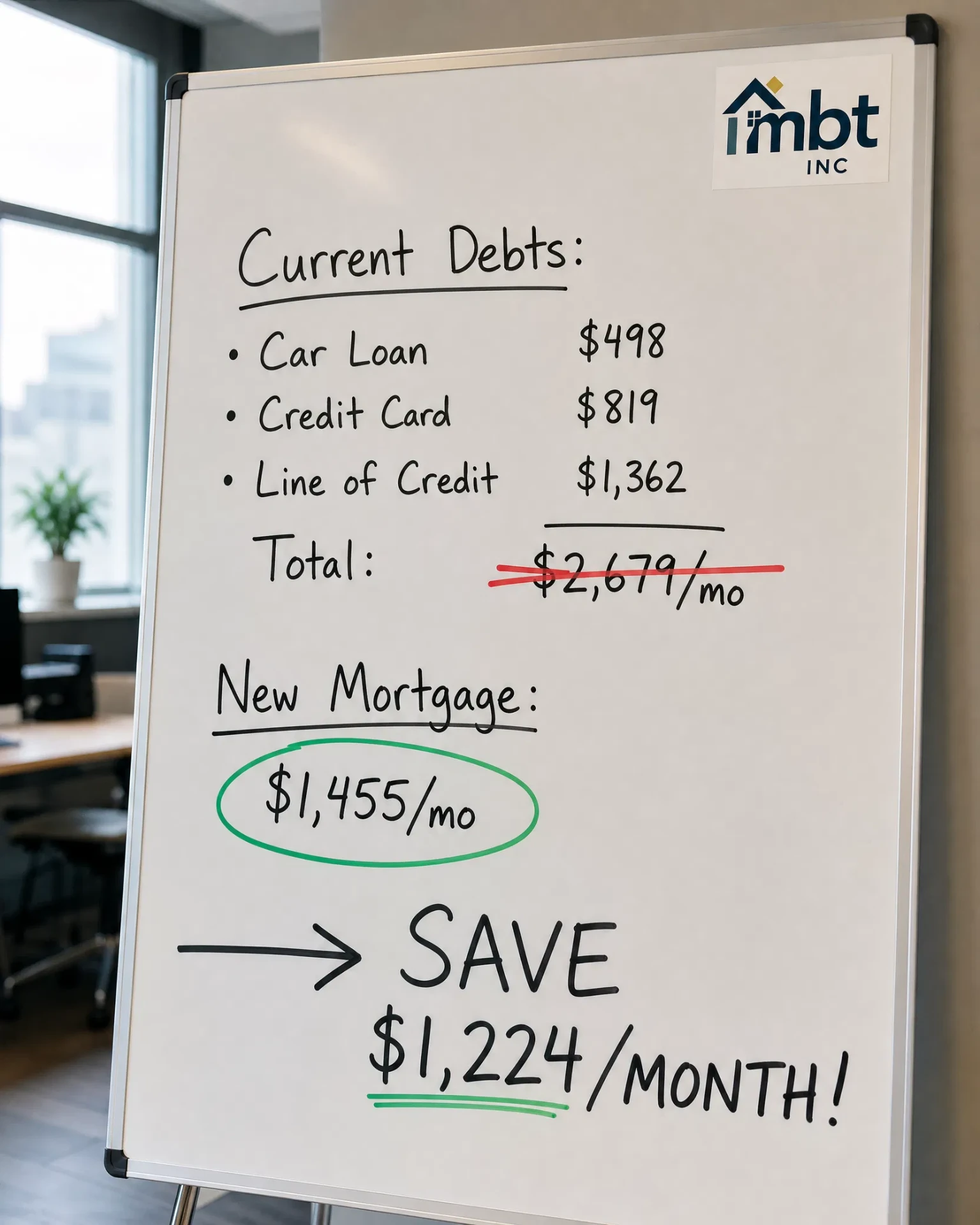
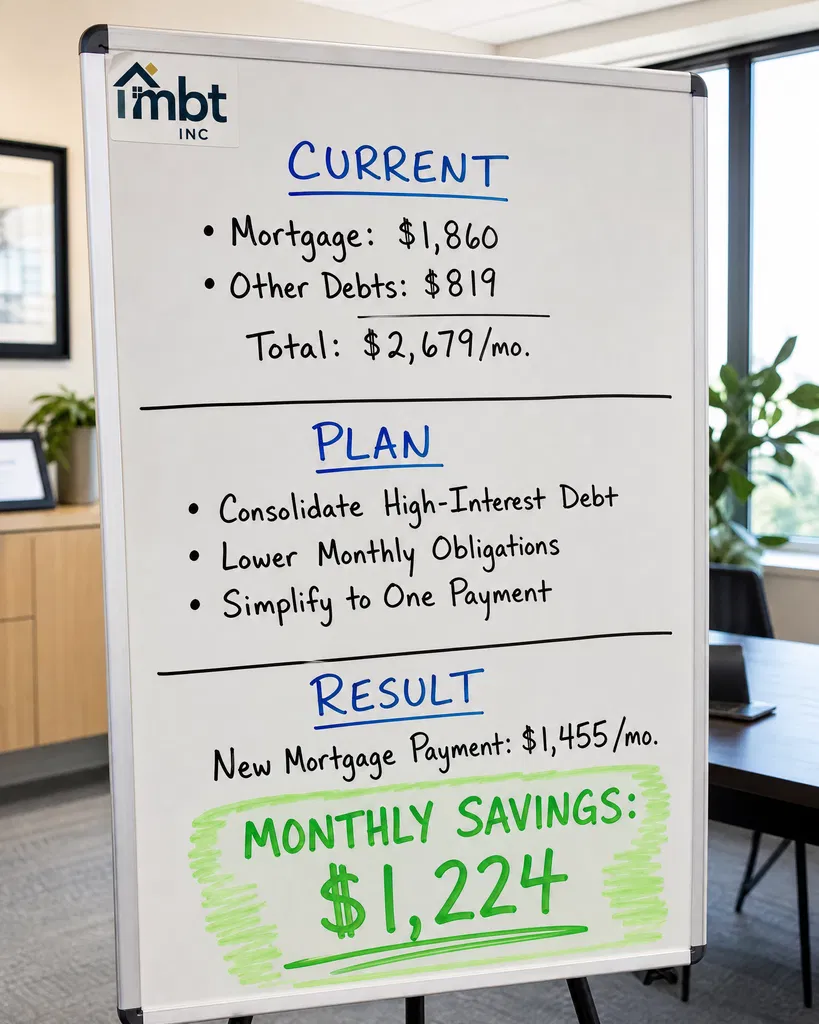
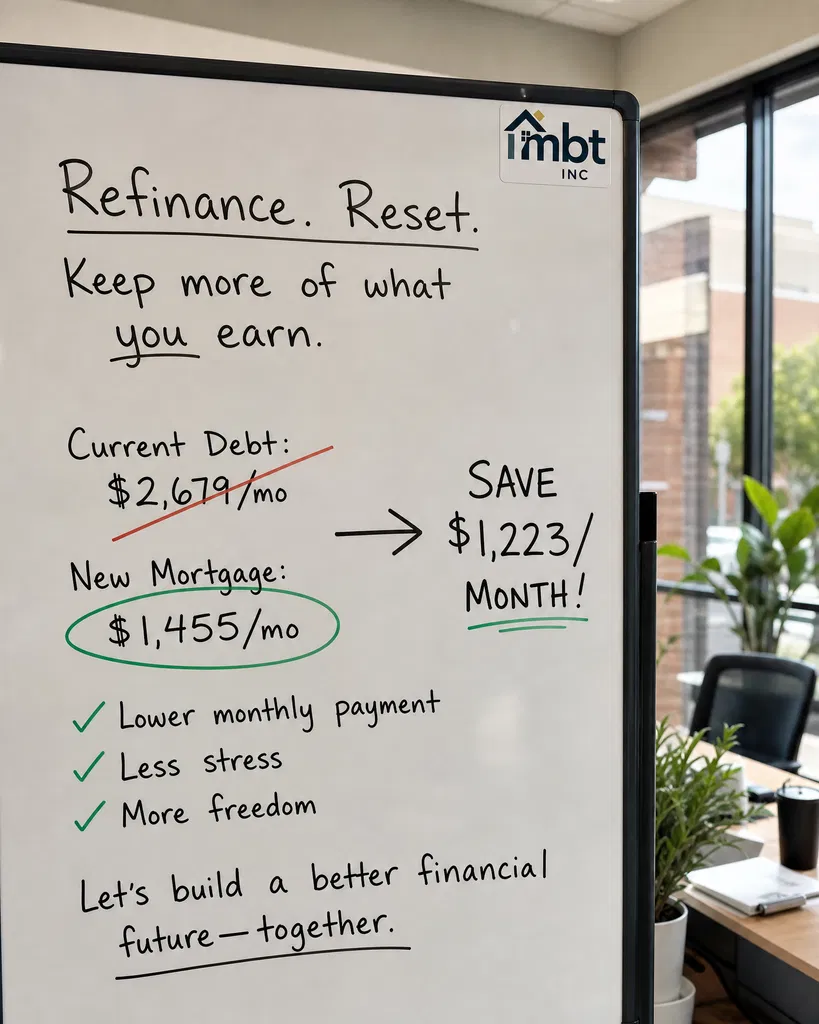
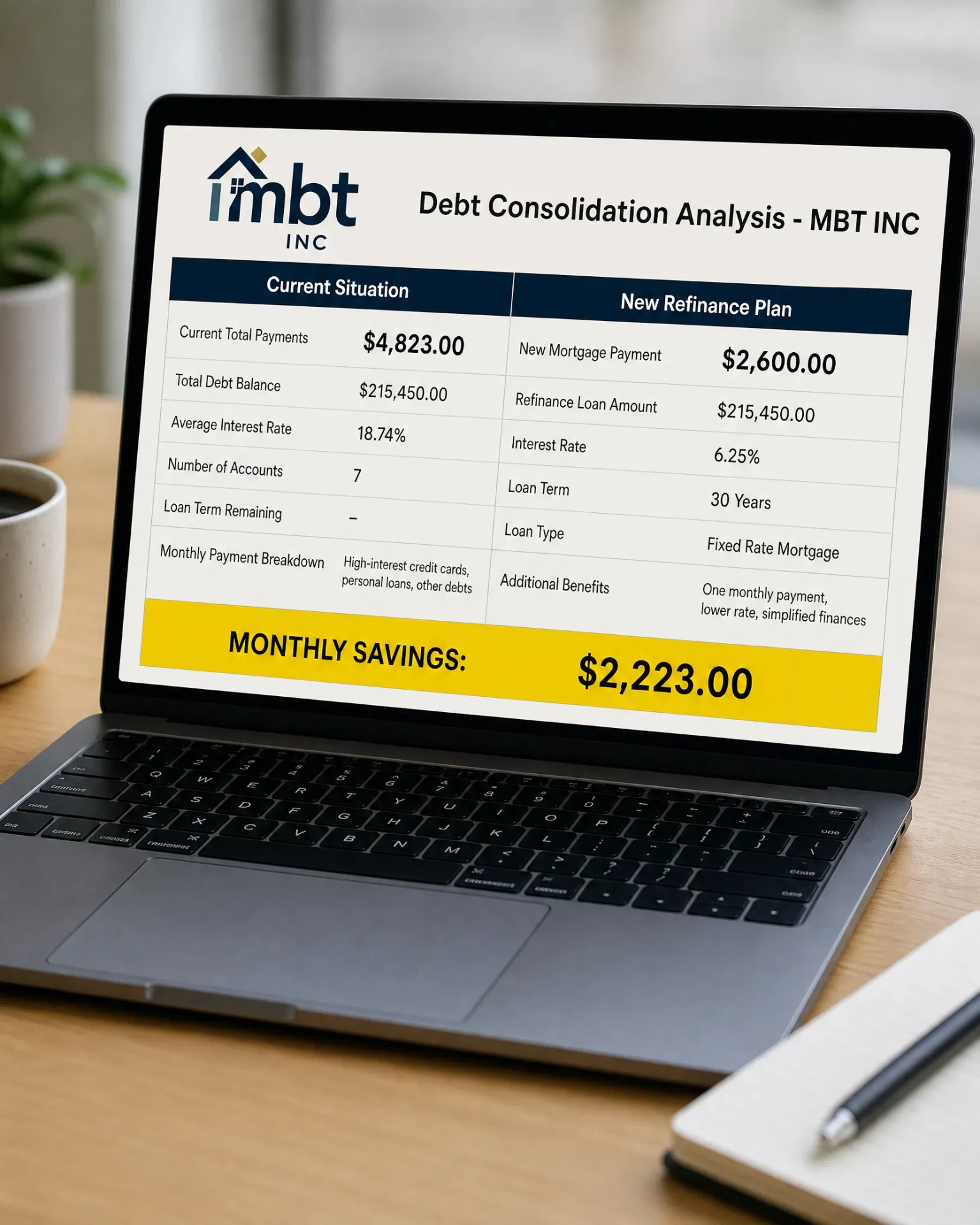
Your debts on one board, one payment on the other
This is the same walkthrough we do together — real payments, the new single mortgage payment, and the monthly difference circled.